 |
 |
 |
 |
 |
Volume
5 - Issue 02 FEBRUARY 2007
|

|
 |
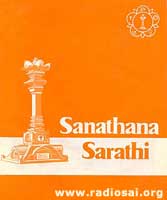
Sanathana Sarathi …RECREATING A 'PRASANTHI' IN EVERY HOME
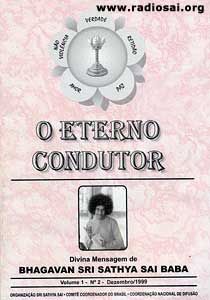
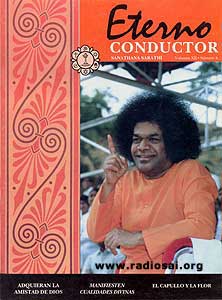
“The monthly gift from Prasanthi Nilayam has arrived again! What a joyful and comforting feeling it is! The Sanathana Sarathi sitting in our mail box brings along with it, something indescribable, an inexhaustible stream of inexplicable happiness…it brings to our home Bhagavan Himself! Not yet having laid our eyes on one word within its sanctified pages, we hear His soft voice, see His warm smile and feel His caring gaze…We feel His presence…our eternal guide and closest friend, our Sai, is with us, very near and very real.” This is the experience not only of the Shiva Gopie family living thousands of miles away from Prasanthi Nilayam in the North American city of Toronto, Canada, but of hundreds and thousands of devotees and spiritual aspirants spread from California to Cameroon, Suriname to Slovenia, and Tanzania to Tokyo who are the blessed recipients of this ‘Prasadam from Prasanthi’ – the Sanathana Sarathi. The Lord’s will is indomitable, impassable. “The sky may fall and break into pieces but Sai’s will must prevail,” thundered Bhagavan in front of thousands just a decade ago. In 1962, on that auspicious evening of the holy ‘Festival of Austerity’ – the celebration of Shivarathri, while enunciating the virtues and vital mission of this hallowed magazine on its fifth anniversary, Swami declared, “The 'Sanathana Sarathi' is the result of My Sankalpa (resolve), My Uthsaaha (venture), My Aanandha (bliss). Nothing can stand in the way once I have decided on any step.” And for five decades by then, this unique instrument of the Lord has incessantly and indefatigably taken the immutable message of universal love and perpetual peace to the hearts and homes of every sincere spiritual seeker and searcher of divine love. “The moment I see the publication in my mail box, it instantly takes me away from worldly interactions and puts me right back in Prashanti Nilayam with the feelings of what I am and who I am….it is a direct link to beloved Swami and the Ashram. Without this publication or the transliterations of it and His unique and special message of inherent divinity, I cannot imagine what my life would be. Each issue emphasizes the principal ingredients of life - absolute love, wisdom, and knowledge, and enlivens every cell of my being,” says a devotee from New York who has been subscribed to this magazine for nearly two decades now. For Mrs. Kirsten Pruzan from Denmark , the Sanathana Sarathi is “like an umbilical cord to Prasanthi Nilayam – the abode of Supreme Peace.” “The articles and pictures of Sanathana Sarathi show that life is a combination of spiritual and material energies. It demonstrates how we can make our life a work of beauty, love, enjoyment and clean fun if we have the yearning,” the joyful Perampalan Murugasu from Remuera , New Zealand says.
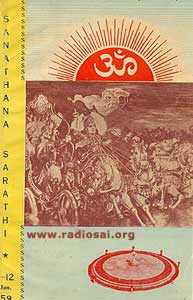
And significantly enough, in His thirty second year Bhagavan unfurled this unique conduit of His mission and message on a no less significant day than the occasion of Maha Shivarathri. It was February 16, 1958 when Bhagavan blessed the first few copies of this newest ‘manifestation of His will’ to be distributed freely to all present. [Interestingly, after five decades while Sanathana Sarathi celebrates its golden jubilee, the Sun and the Moon are so aligned that Shivarathri falls on February 16 this year too!]
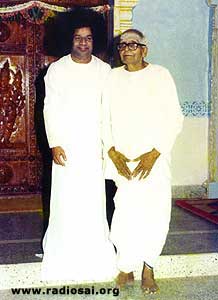
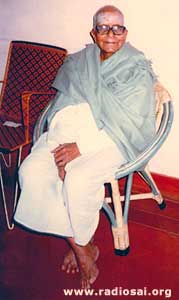
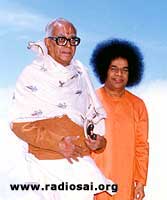
But why the name ‘Sanathana Sarathi’? Could it not have been ‘Divine Love’, ‘Sai Speaks”, “Unity to Divinity” or anything similar? And who christened it so? Prof. Kasturi, the Lord’s hand-picked mission-man and the first editor of this magazine, narrates a beautiful incident to put to rest all such often queried queue of questions. “I got the good news pretty quick; Baba had come to Bangalore . He was staying in Sri Vittal Rao's house on the 9th Cross Road , Wilson Gardens, only 5 minutes away from my residence, ‘Ashoka’ on the 12th Cross,” writes Prof. Kasturi in his biography, Loving God. “Knowing that there was a possibility of His coming to his place, I had tipped the dry cleaner, who attended to the washing and ironing of his door and window curtains, to inform me as soon as he delivered the wash to Vittal Rao. I had noticed that he had the curtains washed and ironed as part of house-cleaning, preliminary to Baba's visit. When the news leaked at last, I posted the little daughter of my domestic help on a slab of stone facing his house, with directions to keep watch for a big car and an orange robe. So within ten minutes of Baba's stepping into his house, Vittal Rao was amazed to find me on his verandah! “Wait! Wait!” he pleaded. But Baba spotted me and came towards me with His palm ready to fall on my shoulder. “Now, you have to work at Puttaparthi”, he said. “A monthly magazine will start soon. Guess! How is it named?” He asked. I confessed I could not delve into His Will. Yet He drew out from my reluctance a few names. “The Godward Path”, “Karma Dharma ...”, “Premayoga.” He waved aside the titles I suggested and announced that he had decided to designate it as “Sanathana Sarathi!”
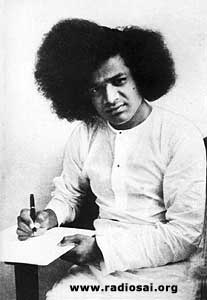
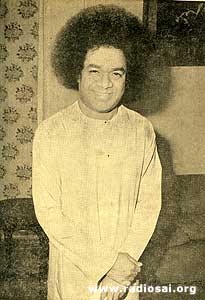
Who else but the parents name the child, isn’t it? The “Sanathana Sarathi” is a product of His divine love, to share love and transform every being into a beacon of love, just as He is. And so, from its very beginning, Swami took great care of it. Apart from appointing a man of supernormal caliber and competence like Prof. Narayana Kasturi, who had a plethora of popular Kannada and English literature to his credit and also had served as Assistant Director of the All India Radio (in fact, he was one who named the all-India radio broadcasting service ‘Akashvani’ which has stuck on permanently since India’s pre-independence days); personally visiting Bangalore to ‘Vichara Darpan Press’ in Avenue Road and buying a foot-operated treadle printing machine along with a case of Telugu and English types; setting up the ‘Sri Sathya Sai Press’ in Prasanthi itself right next to His residence in late 1950s; appointing people and selecting volunteers to serve in the press as well as aid Prof. Kasturi; visiting the press every other day to correct, direct, instruct and inspire; laying down clear and austere guidelines with respect to its content and format; even Himself editing articles on many occasions– Swami was concerned about every single detail. And just like a mother would sacrifice everything and go to any extent to take care of her just born infant, Swami too, embarked on an exercise that was hitherto unprecedented by any standards in any age – The Lord decided to take the pen Himself. And this was perhaps, thegreatest demonstration of Swami’s immeasurable love and immense concern for Sanathana Sarathi (and through it to all mankind). It was epoch-making. Imagine God himself writing week after week! Imagine if we had the Bhagavad Gita written by Lord Krishna Himself and not by a third party! Imagine having Lord Rama’s life story in His own hand-writing! For the first time, the Avatar acceded to document His message Himself. Perhaps, this is the best way the purity of His preaching could be preserved, and the destiny of mankind could be rewritten to save it from impending peril in the present Kali age.
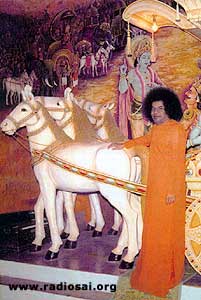
‘Sanathana’ means ‘Eternal, the timeless one’; and ‘Sarathi’ implies ‘Charioteer’. “Recognise God as the Sarathi (the charioteer of our life), yield wholeheartedly to His direction, reach your Destination in good shape”, is the message that Bhagavan is conveying through the name,” Prof. Kasturi explains in ‘Loving God’. In reality, it is not a name; it is an announcement, a divine proclamation and reaffirmation that Bhagavan is the Omniwill, which is moulding and manipulating, since Time began, the wills of living beings from the amoeba to the astronaut. It is a clarion call to cleanse our hearts and souls, and create an ambience for Him to install Himself in us and lead us to truth, goodness, joy and bliss.
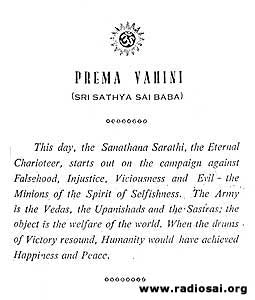
Innumerable are the instances when God has converted a ‘stormy tornado’ of someone’s life into a ‘serene sea’ when they allowed Him to take over the reins of their lives. Dr. Y S Thathachari, a dedicated biophysicist who had worked for some years at the Massachusetts Institute of Technology and after that at Stanford University and the University of California, suffered in 1960 ‘aggressively malignant and metastasising tumours in the skull, the neck, the ribs and the hips, the cancer having the features of both Ewings and Retiaulum Cell Sarcoma.’ It was a death sentence enveloped in medical abracadabra! Prof. Kasturi reports in Sathyam Shivam Sundaram. The surgeon finally told him, 'Sir, miracles do happen. We hope such a miracle would happen to you.' This was in 1962. The couple returned to Madras (now Chennai) and the doctors in Madras pronounced that even the liver is now affected with cancer. “In 1965,” Tathachari says, “I felt like seeking the blessings of Bhagavan Sri Sathya Sai Baba, following a chance reference by a friend. Baba blessed me and my wife and directed us to go back to Stanford, continuing the Endoxan, if I wished to do so. In 1970, when I approached Him again, He asked me to discontinue all drugs and dietary supplements. He gave me an assurance of cure and dispelled that ever-present dread of recurrence." Thathachari later pursued his teaching assignment and research projects in America with undiminished zeal. The ‘miracle’ had indeed happened. The reason we quote this particular incident, though there are innumerable of such ‘divine graces’ happening anytime all over the world, is to bring to attention a few powerful and profound words that Bhagavan wrote to him many years later. “Busy yourselves with the duties which are entrusted to you, in good spirit and fine health,” Swami’s initial lines in the letter to Thathachari read. But what came later is most significant. “Sai is ever by your side. He is the charioteer of the vehicle of your life. The ship of life, however heavily loaded with the cargo of joys and sorrows, can certainly arrive at the harbour of self-realisation, if it is propelled by holy mental energy. Repetition of the Name is the 'dug-dug-dug' of the pistons; the steering wheel is love; the anchor is faith. Continue the journey in confidence. Sai is always guarding you from harm and pain…Swami is constantly showering His compassion on you. He counsels you from within and corrects you. On your part, be immersed in the duties entrusted to you; remember, that is Swami's work. When you discharge your duties, convinced that the work is Mine, health and happiness will be added unto you." Bhagavan, in so many comforting sentences, conveyed how glorious one’s life can be if He is made the Charioteer. It is these sweet and soothing words of the Lord, dripped in divine selfless love, which are His most potent weapon to induce man to pause, reflect, reform and then reestablish himself in peace. “Whenever I or my family members felt dejected and hopeless in challenging situations, the postman's knock on the door and delivery of Sanathana Sarathi would bring renewed hope and succour in the form of a word of encouragement, or a solution to the problem. It is a harbinger of good hope,” says Dilip Trasi from Mumbai. The very first article in the inaugural issue of Sanathana Sarathi was Bhagavan’s ‘Prema Vahini’, or the ‘Stream of Divine Love’. What else could it be, when Bhagavan has declared that if you ever want to give Me any appellation, call me “Premaswarupa or the Embodiment of love”, for “Love is my form; Love is my instrument.” And each devotee’s life is a testimony to this unconditional all-encompassing love of Bhagavan.
For twenty-five months till February 1960, Swami assiduously penned for mankind the challenges and characteristics, norms and nuances of Divine love. Once and for all, Bhagavan settled the age-old controversy on the relative status of the three paths - Bhakti, Karma and Jnana (Devotion, Action and Knowledge) - that lead to God. He explained, "I do not agree that Bhakti, Karma and Jnana are separate. I do not place any one before the other, nor will I accept a mixture of the three. Karma is Bhakti; Bhakti is Jnana. A piece of candy has taste, weight and shape; the three cannot be separated. Each bit has all the three; we do not find shape in one bit, weight in another and sweetness in the third. When the candy is placed on the tongue, the taste, the weight and the shape are simultaneously experienced. Similarly, Jnana, Karma and Bhakti may be truly experienced only as one whole." Karma is love in action, Jnana is love experienced and Bhakti is love universally shared. Thus, Baba dismissed in one stroke all disputations about the superiority of any one of these disciplines over the other.
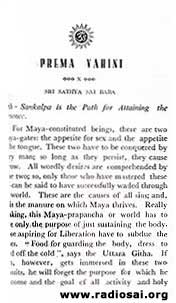
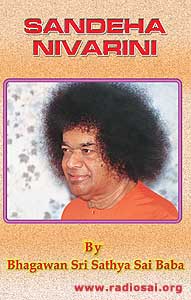
Just after three months of Prema Vahini, the compassionate Lord in May 1958 started another divine series “Sandeha Nivarini” (or the Clearance of Divine Doubts). Swami, interestingly, played a dual-role in these articles, that of the ‘inquisitive devotee’ as well as the ‘enlightening guru’, so that, perhaps, devotees can relate to it better and grasp its essence faster. A typical conversation in this series goes like this – Devotee: What is the use of confidence and hope when one is not destined? Hope will only cause greater disappointment. Devotee: If one is destined, everything will come of itself, isn't it? Devotee: So, Swami, we should not sit with folded hands, placing all burdens on destiny, isn't it? This is how illumining every paragraph in Sandeha Nivarini is! Till the Birthday issue in November 1959, both these treatises of spiritual wisdom – one fertilizing the devotees’ hearts with pure love and other weeding out any unruly twig or shoot of any hesitation or fear – was proffered to the devotees concurrently by Swami. Sanathana Sarathi, literally became every sincere spiritual aspirant’s lifeline. While all this took the magazine to great heights and it lived up to its mission of “Moral and Spiritual uplift of Humanity through Truth, Righteousness, Peace, Love and Non-violence”, in the days of old when Puttaparthi did not even have a good road, let alone electricity, transport, a decent post-office, etc. and with the old manual typesetting letter press machine (which would take a skilled person a minimum of two days to compose one page), for Prof. Kasturi posting the magazine by the 16 th of every month with the help of just one assistant in the first two years was an ordeal of gargantuan proportions for which he prayed for the Almighty’s blessings every minute. How complex was the process? And how did it actually get done every month in time? Over to Prof. Kasturi for the interesting first-hand account from his biography:
“I was kept busy most of the day and even a few hours of the night, since the number of subscribers increased fast. Money was sent by post or paid direct by devotees and pilgrims, who realised that the Sarathi was the link between the Chariot and the Charioteer. The Register of subscribers became more voluminous with every festival at Prasanthi Nilayam; thousands who came to the holy Presence mired to ensure that the voice of the Lord should enter their doors at least once every month. “For over two years, I and Narasimhachari bore the yoke. We were anxious to post the numbers at the newly opened Prasanthi Nilayam Post Office, on the 16th of every month, as announced in the very first copy. Devotees, we knew, would welcome it even more reverentially when they find, on the wrapper, on the right hand corner, the circular frank-mark of the Post Office with the euphoria-filled name “Prasanthi Nilayam” (Prof. Kasturi was himself the post master for eight months!). But a cutting machine which could trim the edges of the magazine was acquired only much later, long after a cylinder press was installed to cope with the 3000 copies we had to print. They had to be trimmed at Bangalore City , 100 miles away.
“Every month, therefore, after the printing was over, I stuffed the quantity of English and Telugu magazines into two gigantic boxes, took them to Bukkapatnam on a bullock-cart, had them lifted to the roof of the bus proceeding to Penukonda, and ordered the bus to stop near the level-crossing about 300 yards away from the Penukonda Railway Station. The boxes were brought down from the bus and a Tarzanian porter, Narasappa, carried them as head load to the platform. There, I awaited the arrival of the passenger train to Bangalore, 85 miles away to book the boxes as freight. Reaching Bangalore, porters loaded them into horse-drawn vehicles, which I directed to a Press that had a cutting machine. The boxes filled with trimmed copies were then taken to the house of a devotee in the heart of the City. I spent the night there with a dozen young men who volunteered to put the magazines into wrappers (with the addresses on) which I had brought from the Nilayam. The copies were thus ready to be posted and we could sleep through the short hours of the night. The next day, I repeated the schedule while returning – horse-vehicle, porters, railway journey, Penukonda station, Narasappa, level-crossing, bus until Bukkapatnam, bullock cart, and finally the Prasanthi Nilayam Post Office to receive the Holy Name affixed and allow the precious Prasadam to travel to more than 3000 homes! The devotees received it with reverence, thanked the postman who brought the magazine and put it in their altar before reading it.”
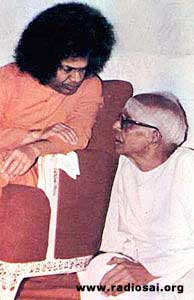
So that was the ‘behind the scenes’ story of perfecting and posting the beautiful Sanathana Sarathi. But it was not drudgery all the time, with the divine beside lightening and brightening the burden at every available opportunity. Prof. Kasturi narrates a very entertaining yet enlightening incident that happened in the second year of the magazine in his ‘Loving God’ which goes like this: “I remember one evening in 1959 when He sent some one to bring me to His room at the mandir. Baba told me that the Editor of a daily published from Hyderabad had asked for my photograph, for he was announcing me in his paper, alongside a nice write-up as the Editor of the ‘Sanathana Sarathi’. Baba had promised to send him my photograph and He asked me to prepare myself for being shot within minutes by Baba Himself, with a brand new camera He had specially selected for the purpose. O! My joy knew no bounds! I rose to the eighth heaven. I rushed down the eighteen steps to reach home for a quick face lift. “I returned to the Presence, within minutes, shaved and starched, with a big broad smile on the frontispiece. Baba held me by the shoulders and positioned me at an appropriate distance. He peered through the lens and congratulated me on my ‘photogenic face’. I was elated that my picture will catch the eye of at least 30,000 readers all over Andhra Pradesh. My smile swelled into a toothless grin! Baba gestured and I swallowed the grin in one gulp. He cautioned me with a ‘steady’, followed immediately by a ‘ready’. He clicked…. A black hairy blotch with a flashing tail bounced on my neck from inside the camera! With a shrill screech, I hopped into the corner of the room casting away the horrid, hirsute….was it a rat? Was it dead? No. It was a cotton mouse….that was cunningly tucked inside the dummy camera, to be released when clicked. Baba had a hearty laugh at my panic. I too laughed to relieve the tension. “He reprimanded me mildly for swallowing the story He had invented to deflate my ego. He reminded me that my being the Editor was not the kind of ‘news’, which the world was interested in. Lasting fame is to be sought not through newspapers, which turn into wastepaper the very next morning, but through dedicated service to God and the godly. I left His room, a leaner and wiser man. “Baba mercifully helps us, slowly and subtly, to shed the burden of the ego….He advises that we should be just ourselves and not wear masks behind which we hide. ‘What greater status can you attain than being the medium for packaging and posting My message to thousands of devotees every month?’ He asked me. Baba is too bright a Sun for human eyes; we can bask and bathe in sunlight but we cannot gaze at Him.”
In Dharma Vahini, which Swami started on the Sarathi’s fifth Anniversary in February 1962, Swami unequivocally gave precise guidelines and yardsticks by which any devotee could decide and decipher for their self if they were in the path of dharma. “Whoever subdues egotism, conquers selfish desires, destroys bestial feelings and impulses, and gives up the natural tendency to regard the body as the self that person is surely on the path of dharma,” Swami explained, and continued, “Such a person knows that the goal of dharma is the merging of the wave in the sea, the merging of the self in the Over-self. In all worldly activities, you should be careful not to offend propriety or the canons of good nature; you should not play false to the promptings of the inner voice; you should be prepared at all times to respect the appropriate dictates of conscience; you should watch your steps to see whether you are in someone else’s way; you must be ever vigilant to discover the truth behind all this scintillating variety. This is your entire duty, your dharma. The blazing fire of wisdom (jnana), which convinces you that all this is Brahman (God), will consume into ashes all traces of your egotism and worldly attachment. You must become intoxicated with the nectar of union with Brahman; that is the ultimate goal of dharma and of action (karma) inspired by dharma.” That is probably as comprehensive and complete, the meaning of dharma can get. And this is just one paragraph. Bhagavan wrote, in all, thirteen timeless pieces on this subject which ended in February 1963.
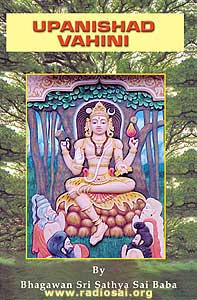
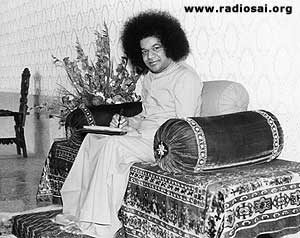
But immediately Swami started another Vahini – the 'Upanishad Vahini' and the highest and most esoteric of philosophical thought flowed from Bhagavan’s pen in a language that a farmer and a fisherman, a potter and a carpenter could understand. Prof. Kasturi, though aware of Swami’s divinity, still used to be stunned seeing the scholastic wisdom and succinct expression of Swami who had not studied beyond sixth class in school. In Sathyam Shivam Sundaram, he narrates a revealing incident: “As editor of the magazine which published serially the chapters of this book, I had an amazing experience every month for a whole year. After dispatching the magazine on the 16th of the month, I would go to Him for the next part of the series. Announcing the name of the Upanishad Himself, He would ask me to wait for a while in His room and proceed along the veranda with a notebook and pen, towards the room where there stood a table with a chair by its side and nothing else besides. Once, it was the turn of the Brihadaranyaka Upanishad to be summarised and simplified. It is the biggest and the profoundest of the ten. I am certain that Baba had never read it or consulted others who could talk on it. And there was no copy available anywhere within miles. But forty minutes after, He moved out with the pen and the notebook as His sole possessions, I could descend the eighteen steps from His room with a ten-page dissertation on the truths this Upanishad enshrined! I peeped into the script as I walked towards the press and my eyes fell on the Telugu words which said, ‘The grandeur of the intellect of the Sage Yajnavalkya is impressively evident in this Upanishad.’ I told myself, ‘The grandeur of the omniscient teacher that Baba is, is now impressively evident to me.’ Narrating his monthly mission of receiving a manuscript or two from Bhagavan, Prof. Kasturi in his biography says, “Proceeding to His presence every month to offer Him the Telugu and English editions of Sanathana Sarathi, I climb the steps in trepidation. I come down the steps with a thrill in the heart and an exclamation in the head, when I am given His contribution in Telugu for the issue of the next month. The length of the article would be exactly the same, month after month. The diction – sweet and satisfying, simple and sustaining – avoids pedantry and prolixity. The calligraphy is charming to the eye. The most complicated metaphysical conundrum is resolved by a parable or a proverb.”
By virtue of his auspicious assignment and also his amazing adjacency to the Lord, Prof. Kasturi was witness to many eye-opening events concerned with the Avatar and His literary mission. One incident recorded by Mr. G V Subba Rao which cannot be missed narrated here, though it happened in such a nonchalant way, is this. “Once just on the eve of my departure from Puttaparthi in a hurry to catch a plane that very morning in Bangalore , I was called by Swami to His modest living-cum resting room in the upstairs of Prasanthi Mandir,” writes late Sri G V Subba Rao who served in the UN Energy division for many years. “Without being told that I was studying Thaittireeya Upanishad (a sacred Vedic text) during my weekend spare time in Delhi (where I was then a resident representative of a UN agency) Baba, in His infinite Grace expounded for nearly one full hour the essence of this famous Upanishad. “When I began to write it all down, Baba remarked that there was no need to take notes; He assured me that whenever the need arose, I would automatically recall His teachings! “While Baba's instruction was thus proceeding, Sri Kasturi, the editor of the Ashram magazine, came up to request Baba for Swami's article for the monthly ‘Sanathana Sarathi’ issue which was just then going to the printer. Swami, then, with a wave of His hand, produced the article and gave it to Sri Kasturi in my direct presence!” The Sanathana Sarathi, is therefore, a creation, an extension, a ‘manifested missionary’ of Sai. Just like the name and the form, the Lord and the message are inseparable. ‘Sanathana Sarathi’, verily, for all its readers, is Sai in black and white. And Swami personally took great care of its purity, sanctity, authenticity and affordability right from its inception.
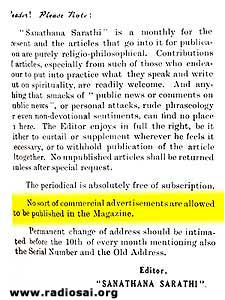
In fact, in the very first issue of the magazine itself it was declared, “Contribution of articles, especially from those of those who endeavour to put into practice what they speak and write out on spirituality, are welcome. And anything that smacks of ‘public news or comments on public news’ or personal attacks, rude phraseology or even non-devotional sentiments can find no place in here.” For many years Sanathana Sarathi had articles and experiences from devotees but every literary piece had to pass these strict stipulations. In the September 1960 issue, for example, there was a revealing story by Mr. P S Menon titled “Significant Words” which said: “Last Dasara (1959), on the day when the poor were fed, I and few others were holding back the thousands, beyond the gate of Prasanthi Nilayam for over two hours, when suddenly, in obedience to someone’s orders, they broke all barriers and rushed pell-mell to the pandal (stage), to the left of the Nilayam! I was very much annoyed that all our labour had gone waste; but, Baba called me towards the pandal saying ‘Menon! Go and see that all are seated in rows. I am coming.’ I went to the pandal and was surprised to see all that motley mass arranged in perfect rows. Baba came there in a few minutes. He walked along the rows, and turning towards me, said, ‘Menon! Look at the wonderful variety of Creation!’ That was a revealing remark. Those words opened my eyes. Yes, there must have been present in that pandal, at that time many pious souls, sadhakas, saints, seekers, pretenders, penitents, idlers, idealists, castaways, misfits, and many other types besides, making up this vast multicoloured panorama of humanity. The scene was not something to be viewed with disgust, as I was prone to; it was something to be watched, and studied with sympathy and discrimination.
“A few hours later when the Feeding had started and Baba had served with His Hand the sweets to the poor, Himself to each and everyone, I was in the kitchen near the pile of the rice, straightening my back to relieve the strain. Suddenly, Baba appeared before us. He asked me, ‘Grand, isn’t it?’ I replied, ‘Yes, Swami. There must be at least three thousands.’ But Baba smiled and said, ‘Not that! The Shanti (peace) and the Ananda (bliss) here now… How is that?” Significant words those two! Yes, they revealed to me my error, in getting disgusted with the noise and confusion all around me. I must have concentrated, instead on the Ananda that the poor got and the consequent Shanti that prevailed in their minds. These were more real, than the noise and confusion, certainly. Thus does Baba, by a casual remark, a word or two, reveal to the ignorant the significance of things and events. He is the Sadguru, the Great Teacher.” Such experiences were more frequent in the initial decade of the magazine. But as devotees’ stories started pouring in profusely and it was difficult to establish which was authentic and which was ‘augmented imagination’, articles from readers became occasional and rare in the magazine. But one salient feature remained, however, – bringing alive breathtaking happenings in Swami’s presence, whether He was in Puttaparthi or on tour to any other fortunate destination. For instance, the January 1959 issue described Swami’s visit to the holy state of Kerala of which a small excerpt goes like this:
“…In the evening (of December 21, 1958), Baba arrived at Kovalam Beach, seven miles away from the City, accompanied by the members of His entourage, as well as many devotees from Trivandrum. At a quite spot on the seashore, far away from the noise and bustle of the Capital, Baba gave those around Him, the unique pleasure of hearing Him sing a number of songs. Everyone joined in the Bhajan that followed; during the Bhajan, Baba ‘took’ (created) from the sands a beautiful image of Murali Krishna and a Gold ring with the Radha-Krishna motif embossed charmingly on it. Being Vaikuntha Ekadasi Day, Baba also ‘took’ Amrita (nectar), this time from His Hands! The Bhaktas (devotees) who sat around Him could sense the captivating fragrance, long before the actual materialisation, and even as Baba was singing a song, He pointed His joint palms at a silver vessel and the ambrosial Amrita gurgled into it from His fingers! Baba then distributed the Nectar, Himself, to everyone present, including a few fortunate fisher folk from the hamlet nearby.” Apart from these scintillating stories, there was also a special section called “Healing Touch” which carried medical miracles that are so common in Swami’s hospitals. Dr. V Brahmam serving in the Sri Sathya Sai General Hospital (the only hospital then) in the October 1960 issue writes, “Sai Prabha (age 8 years) had typhoid fever which ran through full three weeks; after touching normal for a week, she had a relapse. The temperature was 104 steady for four days and thereafter it wavered from 101 to 103. So, she was admitted to the Sathya Sai Hospital .
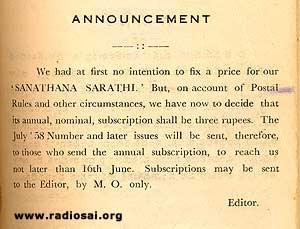
On September 24, her condition caused anxiety; she was talking deliriously from 10:00 PM. But, at 3 PM she called out, in her usual voice, ‘Grandma, grandma! See, Baba has come! Get up Baba is giving me Vibhuti He has applied to my brow.’ We rose and went to the bedside. Yes! There was a big patch of white Vibhuti on her brow! Baba had come in His subtle form and blessed the child. The thermometer showed that the temperature had come down to normal! When I went to Him, Baba made fun of me, saying, ‘Well! What shall I say of your bandobust (security arrangements)? You do not know who comes and goes!’ It was the fifth day of the Dasara Festival; so, hundreds of devotees came to the ward and saw the mark of Baba’s Grace on the face of the sick child.” The magazine, therefore, has been a treat for devotees and spiritual seekers alike right from day one. One very important characteristic which distinguishes it from other similar publications, apart from its crystalline message in candid words, is its complete absence of any commercial intent whatsoever. ‘No sort of commercial advertisements is allowed to be published in this magazine’ - the announcement was emphatic and loud in the very first issue; and it has been this way for five decades now. In fact, the magazine was mailed and distributed to all the subscribers free in the first five months. Only from July 1958, did subscribers pay a very nominal amount. The message from the editor then read: ‘We had at first no intention to fix a price for our Sanathana Sarathi. But, on account of postal regulations and other circumstances, we have now to decide that it’s annual, nominal subscription shall be three rupees.’ “Baba did not favour campaigns to enlist subscribers, donors, patrons, etc. or even acceptance of subscription fees for more years than one,” Prof. Kasturi writes in his biography about the initial years of the magazine.
“He wanted readers to decide for themselves whether they wished to continue the diet which was placed before them. Baba negatived a proposal to post letters to subscribers cautioning them that if they do not pay for another year, the Sarathi would not be sent to their address. ‘Leave it to them. The hunger that hurts is caution enough,’ He said. ‘The Sarathi should be awaited, accepted, treasured and studied with avidity. Missing it must be as saddening as missing a companion on the journey through a strange land,’ He said.” And that was exactly how it was felt especially in those days when, leave aside the internet revolution, even telecom penetration was poor in India . “The Sanathana Sarathi was a lifeline, reaching all the way back to Prasanthi Nilayam, which helped build a sturdy foundation of faith,” recalls Chris Parnell from Australia. “In the days of being a new devotee, it was anxiously awaited in the mails and every issue was studied from cover to cover – the pictures of Swami, the divine discourses. Sometimes I would wake up in the morning and some words, a paragraph, would come to mind and form the focus of the day's meditation and reflection. It was our life raft, our assurance, that monthly beacon of love.” And this perennial source of strength, support and spiritual light was sustained by the Sai Sadguru Himself because the cleansing cascade of divine wisdom from Swami’s heart flowed, uninterrupted. It was Dhyana Vahini (the stream of Meditation) and Prasanthi Vahini (the Stream of Supreme Peace) from Jan 1959 to February 1961. Later, followed Jnana Vahini, Dharma Vahini and Upanishad Vahini – Streams of Knowledge, Righteousness and Supreme Philosophy, offering wisdom, and widening minds for thirty four consecutive months.
In 1964-65, amidst touring the length and breadth of Andhra Pradesh and establishing the ashram in Brindavan, Bangalore , Bhagavan continued to take the pen and out came the glorious Stream of Divine Gospel – the Geetha Vahini. “The Geetha is as a boat, which takes man across from the self-imposed state of bondage to the freedom which is his nature. He is taken from darkness to light, from lustrelessness to splendour,” Swami said and explained, “The way it begins and the way it ends, that gives the clue to the subject which it expounds. The very first verse (of Gita) starts with the words, Dharmakshethre, Kurukshethre..., the word Dharma being the leading word. The last verse of the final eighteenth chapter speaks of Yatha Yogeswarah Krishna and this word, ‘Yogeswarah’ sums up the Dharma that is taught. Thus, it is clear that the objective of the teaching in the Geetha is just this: ‘Remember Dharma; practise Dharma.’
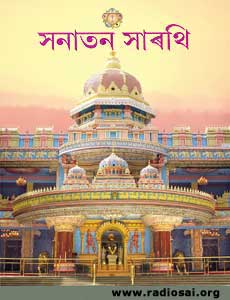
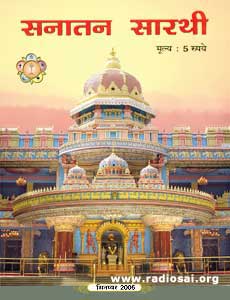
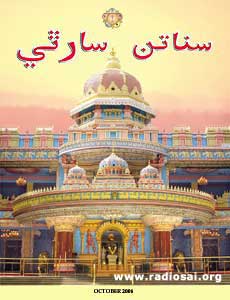
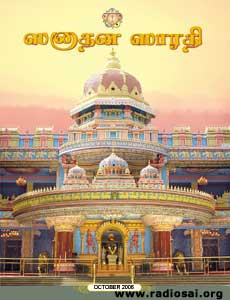
Simultaneously with Geetha Vahini in February 1964, Bhagavan also started Prasnottara Vahini which was a stream of answers to questions on duties of man in various stages of life (who is superior – renunciant or a householder?), clarifications on procedures and principles of social and spiritual practices (Is caste system relevant today? Is the man of action wiser or is the man of devotion? Can women aspire for the highest? etc.) – all in the form of short and crisp dialogues. It was now mid way through the sixties and Prasanthi Nilayam Ashram was separated from Puttaparthi to form a separate township which Swami inaugurated on August 1966. In April next year was held the First All India Conference of Sri Sathya Sai Seva Organisations. In November 1967, Swami laid the foundation for Dharmakshetra in Mumbai and after six months returned to inaugurate the building. Four days after this, in May 16, 1968 was held the First World Conference of Sri Sathya Sai Seva Organisations. Hardly eight weeks and Swami was on the plane on His first and only trip overseas. He returned from East Africa in the same month and inaugurated the Sri Sathya Sai Arts and Science College for Women in Anantapur. It was now July 1968. Palpably, Swami’s schedule was busy, but, in spite of so many engagements and emergence of new projects, Swami never deprived the readers of Sanathana Sarathi their monthly share of ambrosia. As the Avatar’s mission in the present era was unfolding at break-neck pace, in the Sarathi Bhagavan was thrilling the hearts of the devotees with the sweet and syrupy story of His previous Incarnations, especially the Krishnavatar. The Bhagavatha Vahini, replete with the scintillating divine sport of Lord Krishna, was as liberating as it was enthralling. And even though the Sri Sathya Sai Arts and Science College for Men was opened in Brindavan, Bangalore in June 1969 and thousands gathered for the third All India Conference of Sri Sathya Sai Seva Organisations in the November of the same year, Swami’s ‘Stream of the Lord’s Story’ continued ceaselessly. The complete series which was later compiled into a book of 338 pages, says, Prof. Kasturi, “is not just a book; it is a tonic, a balm, a pilgrimage, a hallelujah, a clarion call, a beacon light.” What started as a tiny brook had now become a roaring river, with many tributaries too! Many states in India started their own vernacular versions of the magazine – Hindi, Marathi, Oriya, Tamil, Malayalam, Sindhi, Assamese, etc.
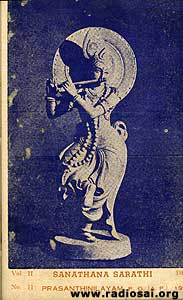
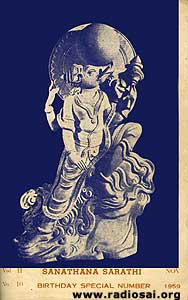
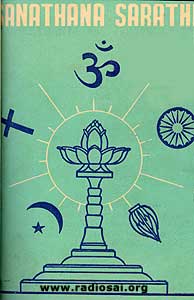
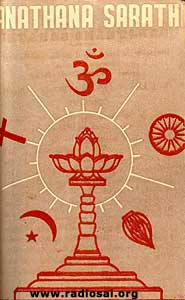
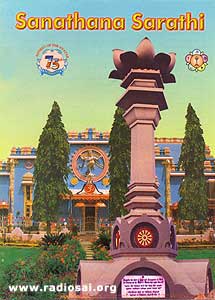
On the cover page, the 32-page magazine always had a simple drawing of spiritual significance. But this was until 1970 when during the Shivarathi festival of that year, Swami drew with a pen of the back of a used envelope, a figure with the holy symbols of the five-major religions of the world, with the Lotus Pillar in the centre, indicating the spiritual aspirant climbing through any one of these paths and achieving success. Since then, this became the ‘poster symbol’ illustrating the universality of Swami’s message and disseminating the mantra - “There is only one religion – the religion of love” from the front covers of Sanathana Sarathi.
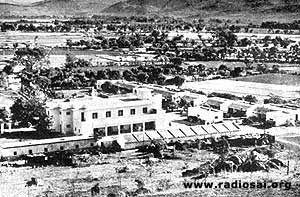
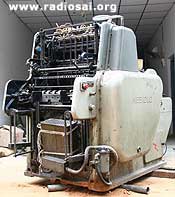
The Sarathi grew at a gigantic pace in early 70s with new wings added to it from every state of India . This was heartening, but at the same time there was a hidden danger too. Because of its sudden expansion with editions in different dialects located in distant destinations, there was a certain element of disharmony creeping in between various vernacular versions. Bhagavan nipped this incongruity in the bud in His benedictory message to all members of the organization assembled for the Fourth All India Conference of Sai Organizations in November 1971, when He said, “In almost all the languages of India and in English, we have a number of periodicals, under different names - Shanthi, Prashanthi, Sudha, Sanathana Saarathi, etc. - causing confusion and complications. So, we shall have only a single monthly magazine in each language called everywhere, Sanathana Sarathi. From now on, it will not be possible for these periodicals to be published according to the will and pleasure of people. If they are left as they are, there is likelihood of lowering of standards and even financial loss for the parties, and consequent distress. So, it has been decided to place the Sanathana Sarathi of each linguistic area, on sound footing, both financially and in the range and authority of content.” Just a few years back, Bhagavan had then formed the Sri Sathya Sai Education Trust to aid the publishing of books written by experienced devotees, and the Sanathana Sarathi too came under this banner. Until 1973, the Sri Sathya Sai Press, which was located on the Eastern Side of the Prasanthi Mandir (which is now called the Pathshala block) had only a foot-operated treadle machine which was later upgraded into a cylinder machine.
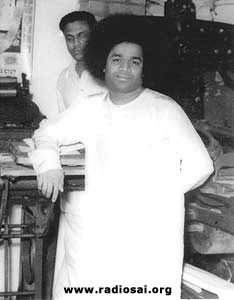
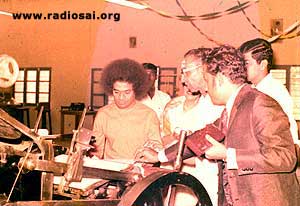
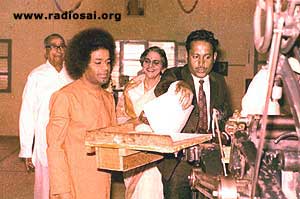
Both these machines were manual intensive to the maximum. Each page of the magazine received by every single reader had to be hand-fed into these inept equipments to print. (Imagine printing tens and thousands like this every month with uncompromising deadlines!) With only a couple of workers and the rest volunteers, it was indeed a miracle of sorts every four weeks how copious copies used to roll out of this primitive press. Of course, there was the divine intervention. Swami used to often frequent the press, sometimes many times in a week, and goad and guide, encourage and enliven the spirits of the dedicated workers. The boys’ college in Puttaparthi still was in the womb of time, what existed then was a ‘Veda Pathasala’ or a ‘School of Vedic Learning’, and all these students in their spare time would contribute their mite to this holy mission. “We used to do typesetting, composing, cutting, covering them in envelopes and every other sundry job,” recalls Sri Ramesh Kasturi, grandson of Prof. Kasturi and one of the first students to join Swami’s Veda Pathasala. “But the amount of work was never a burden…in fact, it was our ticket to bliss,” continues Ramesh with a satisfied smile, “because Bhagavan used to visit often while we were working and spend lot of time joking, rewarding, instructing and inspiring.”
But as the subscription numbers grew to stratospheric heights and the need for a more efficient infrastructure was strongly felt than ever, Swami shifted the whole printing and posting operation to Bangalore. Thus, was born the Brij Brindavan Press, Bangalore in 1973, thanks to the enthusiasm and spirited initiative of an ardent devotee couple, Mr and Mrs Ratan Lal. Interestingly, this was the fifteenth year of the magazine and commemorating this, in March 1973 issue Swami gave a special message to all the readers which said: “Readers are aware that Sanathana Sarathi has been assiduously propagating, during the last fifteen years, unconcerned with decorative display, or the calculation of benefit; that the Integration of the Human Race cannot be achieved by the provision of facilities for mere outward contacts for, it can be realised only by the inner conviction of essential Unity; that Man must need transcend his mental, vital and physical levels of experience and attain the spiritual depths, where the Atma, the Divine is; and that the strength surging from this awareness nourishes the physical, vital and mental levels and raises man to a status above and beyond mere human-ness, into the Divine itself. Sanathana Sarathi is happily entering the sixteenth year, offering to all who yearn for mental, moral and spiritual riches. Sanathana Sarathi celebrates the day as a Festival, with both Form and Feature, endowed with a new splendour.” Yes, the magazine had a novel ‘form, feature… and splendour’, a new Avatar, so to say, on its fifteenth birthday. It had now become double the size; in printing terminology, its dimension was now crown quarto (7 ½" x 10") from the earlier crown octavo (5" x 7 ½"). It had the Stupa adorning the full length of the cover page and after a lot of persuasion, Swami had very reluctantly agreed to increase its annual subscription from rupees four to five.
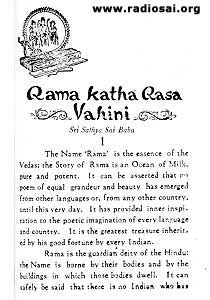
In His special message on this occasion, Swami also reminded all the mission of this one-of-its-kind magazine and stated: “Man can liberate himself, only by knowing himself. He may master the Universe; but, what can he claim to have known, when he has not mastered himself? When he has no awareness of himself, he has no knowledge of the Knower. Sanathana Sarathi has, as its Mission, the assertion of this Truth, its installation in the heart and its establishment in actual practice…. May Sanathana Sarathi flow on, as the Santhosha-Dai (Grantor of Joy); may it swell and surge as Prema-Sai (Bringer of the Love that Sai embodies); may Sanathana Sarathi reside in and find fulfillment in the Sarva-Jiva-Samaikya-Varidhi (All-Beings-`Equality-Unity'-Ocean)! May Happiness, Peace, and Prosperity be attained by all.” It was a downpour of blessings from the divine. Meanwhile, Swami’s Bhagavatha Vahini series had ended and yet another serene stream of the Lord’s story had begun to flow from His fountain tip – The Ramakatha Rasavahini. This series, which Swami continued to write for an overwhelming 91 continuous months spread over eight years, was the most lucid narration of Rama story’s ever. And why not? The same Rama was narrating His own story, and not surprisingly, it was decorated with dialogues and diversions not contemplated by Valmiki (the first author of Ramayana) or any subsequent author. Filled with intricate details and hitherto unknown events regarding Rama’s and Hanuman’s birth, the insightful circumstances related to Rama’s marriage, the never-heard virtues of Sumitra, Urmila or Sruthakeerthi, and many other such additional events and encounters, the Rama story retold by Swami explained many lacunae and missing links that have long disturbed admirers of this great epic.
Swami, indeed, revived the epic to its pinnacle of perfect idealism that it exemplified for mankind. By the time Swami concluded the series in August 1977, readers’ who were avidly lapping up every word of this series had their hearts saturated and minds sublimated with the glory and profound purpose of the Lord’s earlier earthly sojourn. In fact, they could now understand and appreciate the Sai Avatar better. Even after this marathon tale, Swami did not stop or take a break even for a month. After the great epic from India , it was now the turn of India, her precious values and sacred spirituality. In September 1977, Bhagavan penned for all humanity the Bharatiya Paramartha Vahini or the “Stream of Indian Spiritual Values” - a topic very close to His heart. In the first article in this series which had the title ‘The Supreme Reality’, Swami revealed, “The supreme secret is that man must live in the world where he is born like the lotus leaf, which though born in water, floats upon it without being affected or wetted by it. Of course, it is good to love and adore God with a view to gain some valuable fruit either here or hereafter; but, since there is no fruit or object more valuable than God or more worthwhile than God, the Vedas advise us to love God, with no touch of desire in our minds. Love, since you must love for love's sake; love God, since whatever He can give is less than He Himself; love Him alone, with no other wish or demand. This is the Supreme Teaching of the Bharathiyas (ancient Indians).”
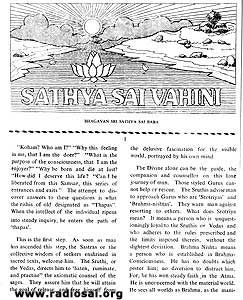
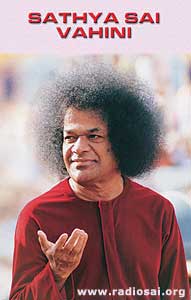
For sixteen contiguous months Swami explained, through enlightening essays, the basic truths that foster and feed Indian Culture since ages before history began. Given the immense importance of these precious eternal truths for the muddled mind of man living in the modern world, Bhagavan, in January 1979, decided to continue the flow of illumination and instruction under a more comprehensive and meaningful name, "Sathya Sai Vahini" - the Ganga from the Lotus Feet of the Lord - "The Flow of Divine Sai Grace". Inside these pages lay strewn pearls of perennial wisdom resurrected by Sai. Sample this. Swami wrote, “Three types of activity reach God and earn His Grace. First, activity not prompted by personal desire; Second, activity emanating from unselfish Love; and finally, prayer arising from pure hearts.”
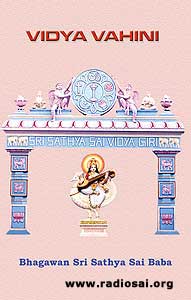
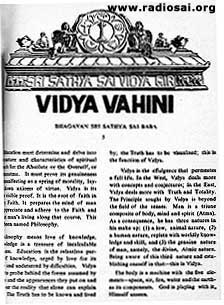
The January 1979 issue, venerating the 21st year of Sanathana Sarathi, was indeed a landmark one because of the exceptional message that Swami passed on to the devotees while inaugurating the rechristened series of Sathya Sai Vahini. He wrote, nay embraced all, stating, "Moved by the urge to cool the heat of conflict and to quench the agonising thirst for 'knowledge about yourself' that you are afflicted with, see, here it comes, the Sathya Sai Vahini, wave behind wave, with the Sanathana Sarathi as the medium between you and me." Truly, Sanathana Sarathi, with its series of invaluable Vahinis, had become every devotee’s soul support. When the Sarathi arrived, they missed Sai less, because it was as if He was sitting next to them, showering His love and shaking off their earthly burden, as Sridevi from Kuwait says, “It transformed our day to day outlook towards life and started making us feel the presence of Our beloved Baba all the time. Apart from leading us into the right path, the Divine messages from Sanathana Sarathi used to console us at the right moments of depression, correct us when we were wrong, motivate us when we were lethargic and shower words of love. We knew, we felt that He is always with us, around us, above us, below us, in us.” In February 1981, Bhagavan concluded the Sathya Sai Vahini with the last article on sociological basis of ancient Indian culture and society. “The four varnas (occupational divisions in society) are the limbs of the Divine body, of the one and only Lord. Caste is the Cosmic Person Himself manifesting as Human Society,” He explained and emphasized, “There is only one caste, the caste of Humanity.” By 1981, it was two decades and three years since Bhagavan had started writing for this holy magazine. But the Divine Hand continued to exert to exorcise the evil tendencies embedded in man for centuries. And so, in March 1981, Sai, the Eternal Educator, started yet another series “Vidya Vahini” – or, the “Stream of Thought Which Illumines”. In the nineteen essays that Swami penned, He candidly enumerated: what is true learning? What is the purpose of learning? And which is the best procedure to learn? The duties and responsibilities of both – the teacher and the taught too were clearly elucidated. Interestingly, this was the year when Swami inaugurated the Sri Sathya Sai Higher Secondary School along with its Primary Wing. Not only that, November 1981, also marked the opening of the grand ‘ Temple of Learning ’ – the Sri Sathya Sai Institute of Higher Learning. Many of the articles in this series were partly due to appeals to Swami by educators and academicians for the elucidation of the principles which must guide one while rehabilitating education as an effective instrument for establishing peace and freedom within oneself and in society.
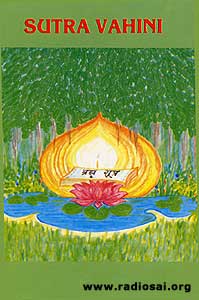
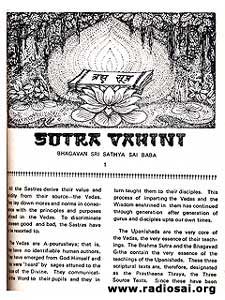
“Bhagavan Baba’s Vidya Vahini is the most authentic version of His interpretation of Education for Life and total Education,” says Prof. S Saraf, the second Vice-Chancellor of Swami’s University, in his book ‘Bhagawan Sri Sathya Sai Baba – the Eternal Educator’. He further states, “It (Vidya Vahini) presents the basic philosophy and concept in its multi-dimensional form covering the entire gamut of life-long education in its various facets from childhood to adulthood; containing beautiful elucidation of methods for reaching the goal.” With the opening of the deemed university in Puttaparthi, Swami, the Chancellor, was well-occupied with shaping this edifice, still His role as the ‘Chancellor of the Universe’ and His compassion for mankind propelled Him to continue to communicate the essence of spiritual wisdom, and that is how, in October 1982, Swami put to paper the “Sutra Vahini”. “Sutra” means “that which, through a few words only, reveals vast meanings". “Brahma Sutras” of ancient India are the multicolored flowers gathered from all Upanishads, and in each syllable it contained a volume of profound philosophical thought. Swami, in His sixteen serial essays, unrivalled these precious spiritual wisdom and placed it in a manner a layman to a litterateur could appreciate and apply them in their daily life.
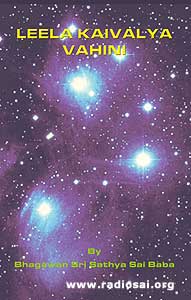
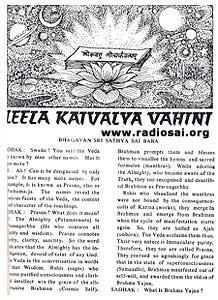
After twenty five years, fifteen series of spiritual volumes and three hundred twelve months of continuous writing, Swami was still not done. As His divine mission was unfolding with the Inauguration of ‘Trayee Brindavan’- the new Temple at Brindavan, Bangalore and launching the Seva Dal conference in ‘Shivam’ – His temple in Hyderabad in April and May 1984, respectively, Swami, to the devotees’ delight, dished out another divine gem – “Leela Kaivalya Vahini”, the name itself was so ethereal to the ear. True to its name, which meant the “Cosmic Sport of God and Eternal Universal Being”, this series of Swami was meant to purify man’s consciousness in all its facets and fill it with bliss. In March 1984 issue, Swami Himself stated, “From the coming Yugadi (New Year) Festival Day, this series under the name Leela Kaivalya Vahini, will dissolve all such obstacles and fill you with Ananda (bliss). It will lead you to the path of spiritual progress.”
That is what precisely, not only this Vahini but every single page in Sanathana Sarathi, has done to thousands world over. “I eagerly await the monthly arrival of Sanathana Sarathi, and read every word of Avatar Vani, and everytime it gives me a new meaning, a new understanding. I must have read most of the Vahinis time and again, in English and in Gujarati, alone and in group. I read the Bhagavad Gita repeatedly but after I had the nectar of His discourses, every time Gita lends me new meaning and deeper understanding,” says Sri Chandrahas Shah from Mumbai. Dr. Joseph Phaneuf, a MD from USA , says, “The Sanathana Sarathi is my living Bible. Reading the words of the Lord who is walking on earth at this time is the greatest opportunity of many life times…Swami's nectarous words are so simple, straightforward and practical, they go straight to my heart. I try to take at least one point and put it into practice. I have so many opportunities to put His teaching into practice in my daily work as a physician. When I am successful at putting His teachings into practice everything just goes smoother and taking care of my patients is much more enjoyable. Swami reminds us time and time again that service to our fellow man is the same as service to God. This awareness brings reverence, humility, love and great joy to my work with my patients.”
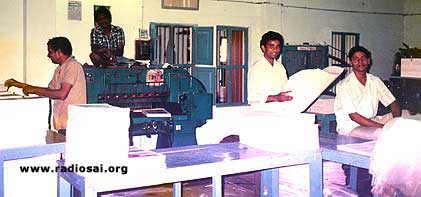
Even though Swami stopped writing comprehensive articles for the magazine after October 1984, His involvement and interest in the magazine was as spirited as ever. Be it the front cover, the inside photos, His discourses or devotees’ articles, every detail was Swami’s concern and under His directions, the Sarathi improved and evolved to even sublime heights. For example, after the mid-eighties, Swami wanted a makeover of the front cover of the magazine. It transformed from various shades of blue, green, maroon, etc. in various previous issues to the sublime and sacred orange. “Swami liked the orange very much and directed that this should be maintained for all future issues without any change,” recalls Sri C M Prakash, a former student of Swami’s college, whom Swami had appointed to serve in the press as early as 1979. “Even a slight deviation in the shade of orange would not be acceptable to Swami,” he adds going down memory lane. It was because of His grace and guidance that the glory of this ‘mouthpiece of the Lord’ only became grandeur every passing day. With the volume of work for the magazine increasing alarmingly, by early 1980s Prof. Kasturi also had help from Sri V K Narsimhan, an esteemed journalist who was the former Editor-in-Chief of Indian Express and winner of the Goenka Award, India 's highest accolade in journalism. Swami appointed him as the Associate Editor of the magazine. The mid-eighties saw sweeping changes in Sarathi’s printing, production and distribution. Swami decided it was time for the magazine to be printed in Puttaparthi itself and so, in a few weeks all the press infrastructure was shifted to the spacious Eswaramma High School where Swami has allotted few rooms to be used for the revived ‘Sri Sathya Sai Press’. This was in June 1986. (For a few months while the machinery was being shifted and installed, the printing job of Sarathi was outsourced to a printer in Chennai).
But this time, Swami wanted the press to be run and managed by His students alone. “Is anybody willing to join the press?” Swami asked the selected group of boys He had picked to take with Him to Ooty in 1985. Before anybody could answer, Swami looked deeply at Mahesh Reddy and queried, “Are you ready to go for training?” Swami wanted to send two boys to Cochin to get acquainted with the working and maintenance of the printing machine.
Mahesh Reddy was silent and hesitant, not because he was uninterested to work in the press or disinclined to stay back and serve in His mission, he was sad because he will be missing Swami. “It is only for 18 days, after that you will again be with me,” Swami explained with motherly love, and consoled him further saying, “When I go to Brindavan, you manage, isn’t it? It is because you know I will come back. It is the same here. After a few weeks you will come back to me.” But Mahesh was still not convinced. “After Ooty, Swami wants to send me to Cochin , while He will proceed with all the other boys to Kodaikanal,” this thought was too depressing for him to deal with. But the all-knowing Swami assured him, “I am not going to Kodaikanal. I will return to Brindavan after the Ooty trip.” To get him more interested, Swami said, “Kerala (the state in which Cochin is located) is a beautiful land. You can go for sight-seeing there. I will make all arrangements for your trip. Now be prepared.” That is how Mahesh and another student Swami had picked went to the HMT factory in Kalamaseri (Ernakulam district of Kerala) to learn the methods and maintenance of printing machines. After their training, before they started on their return journey, they sent a telegram to Swami informing Him of their arrival to Brindavan. And receiving their message, the sweet Lord, who was about to return to Puttaparthi that day, stayed on for one more day in Brindavan to lovingly receive them and fill their hearts with His tender love.
The next morning as soon as Swami saw them, He beckoned them and enquired about their welfare. After the morning darshan, Swami called these two boys inside along with other elder devotees for a long private session during which Swami asked literally about every little detail of their stay and training. “Where were you having breakfast?” “Was the food inside the factory good?” “Did the factory canteen provide dinner too?” “How was your health?” “How did you find the training?” “Were the people there cooperative?”...Swami, like a concerned care-taker, wanted to know everything. Later, when Mahesh and his student-brother offered to Swami the balance amount that was unspent from what He had given prior to their journey, Swami like a proud mother looked at the senior devotees there and said, “See, my boys, they use money judiciously and return the remainder amount, had it been outside boys they would have loaned and spent more.” After a couple of days of their arrival to Puttaparthi along with Swami, He blessed the two on an auspicious day saying, “Join the printing press today.” Swami even visited the press on that day and inspected the equipment and their working environment. Their joy then knew no bounds.
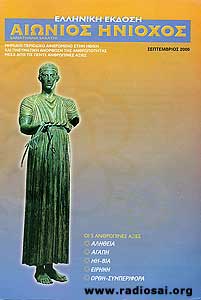
After a few months into work, when Mahesh was not completely happy in his heart, Swami sensed this and during one interview He gave to the working staff of the ashram, told him, “I know, you are not happy.” It was not the work that bothered Mahesh but its time-consuming nature. He missed darshans and bhajans on many occasions and this always saddened him. The loving Swami knew the devotee’s pain as well as its panacea. He called him near and said, “See, you are doing such a sacred job, printing the ashram magazine. This goes to so many people all over the country and the world. It is no menial job, its significance is immense. What you are doing is actually ‘Virat Eshwara Seva’, or ‘Serving the All-pervading Cosmic Lord’. So never be unhappy.” That is how Swami took care of each selected staff of the press. His interest and involvement with the magazine in its every operation, right from its inception, never diminished. Even now, Swami approves and at times Himself selects pictures to be placed on the first page of the magazine. From its very first issue, the first copy of the Sarathi from the printing press is always presented to Swami. The Sarathi has always been Sai’s shining light guiding mankind and at no moment did Swami take His caring eyes away from it. In 1987, when Prof. Kasturi shed his mortal coil, Swami appointed Sri V K Narsimhan as the editor. A widely-travelled journalist who had served in three national newspapers of India for half a century, Sri Narsimhan was the right man for the job at a time when the Sarathi was becoming increasingly international. By the early nineties, there were editions of Sanathana Sarathi in various foreign languages like Japanese, Nepalese, Spanish, Greek, etc. Sri C M Prakash recalls that Sri Narsimhan used to call the magazine a ‘monthly miracle’. It was amazing how with seemingly inadequate infrastructure and limited staff, the thousands of copies could be printed and shipped to various corners of the world. There were subscribers of the magazine from even countries like Curacao , Estonia and Rodrigues Islands .
The way the magazine has sometimes ‘found’ its subscribers, is also very amazing. “In the summer of 1994, I was visiting India from America,” says Dr. Raghu Nathan, a radiologist. “At that time, Swami was residing at Brindavan, Bangalore. I had a desire to start subscribing to the Sanathana Sarathi, however, I did not know whom to contact to initiate the subscription. While waiting for Swami's Darshan, I expressed this wish to an elderly and pious gentleman who was standing in line just behind me. And imagine, this person turned out to be the co-ordinator of overseas subscriptions for Sanathana Sarathi! He, then and there, took my address and finished whatever formalities required, and when I returned to America, the current issue of Sanathana Sarathi was waiting for me in my home! This may just be a co-incidence; but, for me, it was a Sai-incidence! Living far away in California , the Sanathana Sarathi is the monthly prasadam from Prasanthi Nilayam I eagerly look forward to.” Vincent Green, another devotee from Scotland, says, “I had a good dream before I got my first issue of Sanathana magazine. I dreamt I was in a library and Sai gave me sweet oranges to eat - lots of them. I now believe it is the small and sweet pieces of wisdom that I was to receive that Baba was referring to.”
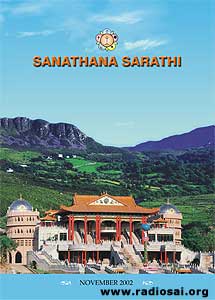
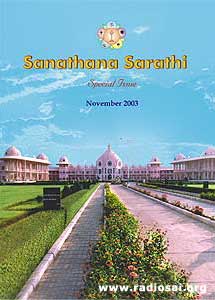
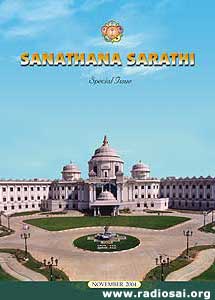
The ways of the divine are beyond the kin of human understanding. In fact, it was He in His inscrutable way, who was writing the articles, enlisting subscribers and running the whole show. Yet at the mundane level, Swami has been ever guiding and directing all who were concerned with the magazine. When the need for a greater space and new infrastructure was felt, Swami directed the press to be moved for the final time to a new location, now inside the ashram compound itself. It is in this spacious location that the Sri Sathya Sai Press operates today with the latest offset machine and a string of volunteers to help. And just like the previous occasion, Swami again sent two of his students to learn the mechanics and maintenance of this new machine to Kolhapur, in the state of Maharastra. When they returned after two weeks of training, they became invaluable assets to the press, and in extension to the Sai mission. “It has been a great opportunity and privilege to be part of this holy endeavour and I am ever grateful to Swami for the role he has gifted me with, however small it may be, to be part of this glorious mission,” says Saravanan, one of the students who joined the press in 1995. The saga of the Sanathana Sarathi is no different from any other mega service project of Swami; in fact, it is much grandeur with a glorious fifty year history. It was the one which carried thrilling accounts when Bhagavan announced the setting up of the Super Specialty Hospital in Prasanthi Nilayam, the mega water project for Anantapur, the setting up of the second medical marvel in Bangalore, the opening of the Chaitanya Jyothi Museum, or even the recent water projects in Chennai and the two Godavari districts (East and West) of Andhra Pradesh. And it is these ‘mass miracles’ of Swami that the magazine had as its cover pages in the last five years (departing from the more-than-a-decade-long Orange ) under Swami’s guidance. With the passing away of Sri V K Narsimhan, in May 2000, the magazine had a new editor appointed by Swami, Sri G L Anand, an experienced educationist who has served in the NCERT (National Council of Educational Research and Training) for decades, and an ardent devotee of the Lord.
Over the years, editors have changed, the content composition has undergone many alterations, the aesthetics have greatly improved, the subscription has grown exponentially, and the magazine has reached virtually every corner of the globe, but the Master and His mission for this magazine has remained the same. As Prof. Venkataraman says, “Sanathana Sarathi has been the Lighthouse of Sathya, Dharma, Shanti and Prema, in a world that is otherwise spiritually dark.” In the modern times when the media has become a ‘play of money’ with even reputed media groups willing to pass on anything ‘that can sell’ as news, not giving a penny’s worth of thought about its impact on society or its younger generation, and willing to compromise and commercialize anything and everything with the logic that ‘otherwise it is not going to sustain’, the Sanathana Sarathi stands as a role model, just like all other Swami’s service projects. It is the pristine purity character of the Sarathi which has endeared it to lakhs of devotees and spiritual aspirants world over today.
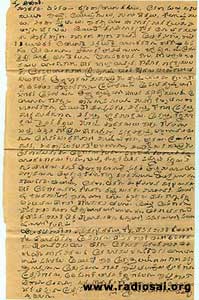
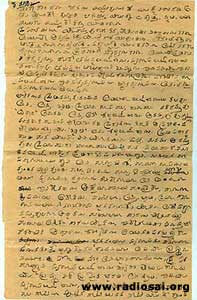
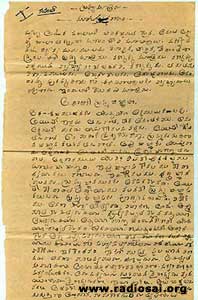
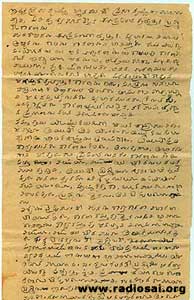
If Arturo Salazar from Venezuela says, “It is the perfect food for my soul,” or if Ravi Rudra from New Zealand joyfully shares, “As I read the articles, I feel the Lord directly communicating with me to inspire and transform me so that I may be like Him,” or for that matter, if Perampalam from Auckland testifies, “I have now greater awareness of my innate divinity and purpose in life, and the need to express this in acts of love, fellow feeling, sacrifice, selfless service, helping ever and hurting never”, it is because the magazine has touched their lives like no other. Truly, what the Sanathana Sarathi has achieved is perhaps incomparable to any other mega service plan of Swami, purely because its mission, modus operandi and immeasurable impact have been so mind-altering. It has worked on a totally different dimension than other massive projects of Swami in subtly, slowly but surely bringing out the best in each human being, and raising his consciousness to a new realm of peace and bliss. What transformation it has inspired in the minds of its readers, perhaps can be best expressed in a poem that Bhagavan Himself penned for the 59 th Birthday issue of this ‘Divine Carrier’ of His timeless message. Let’s ruminate on this enlightening message and elevate our lives.
– Heart2Heart Team
|
|











| You can write to us at : h2h@radiosai.org |
Vol 5 Issue 02 - FEBRAURY 2007
|
Best viewed in Internet Explorer - 1024 x 768 resolution. |